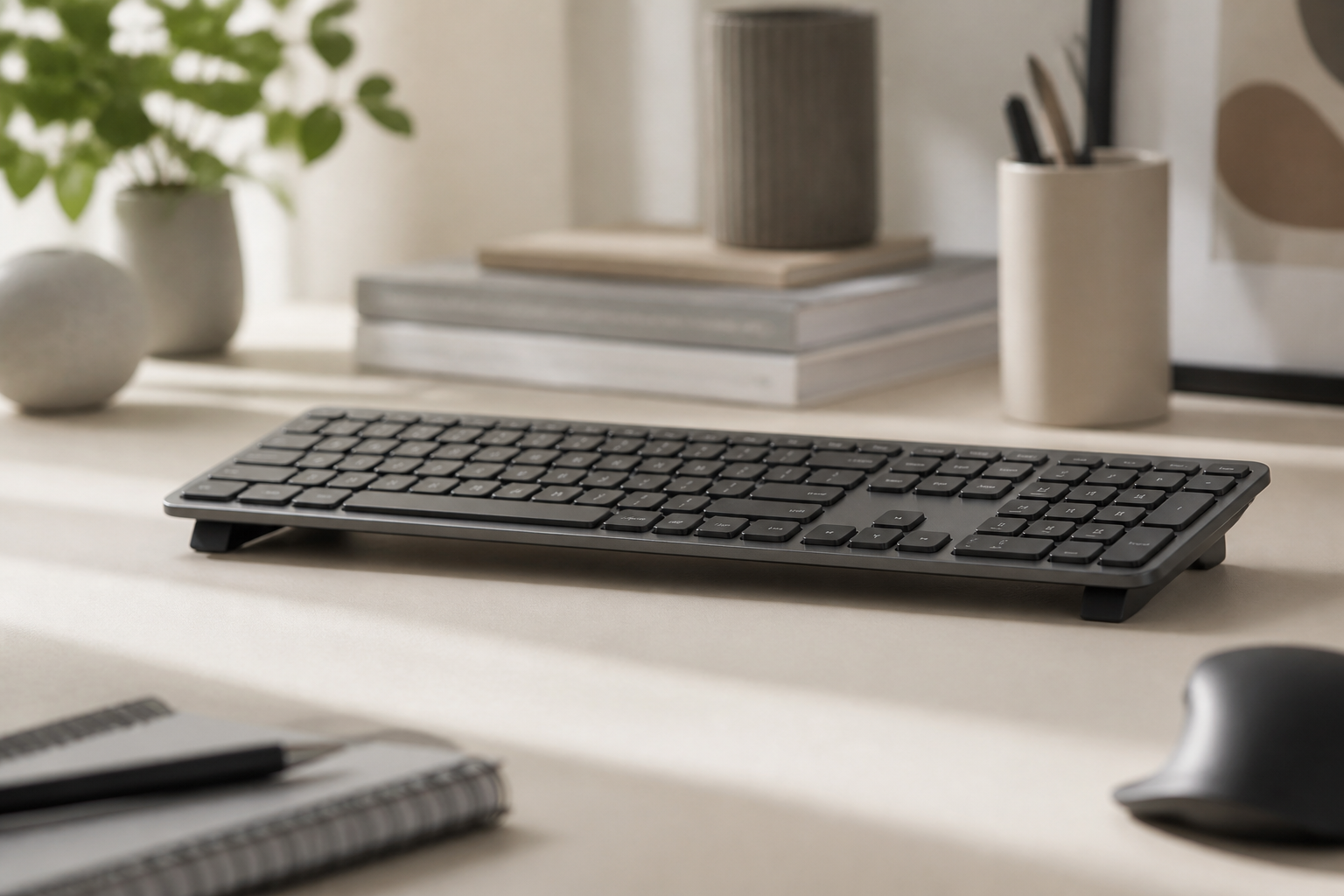
Logitech MX Keys S2 Rumors: Will It Fix Ergonomic Flaws?
Logitech MX Keys S2 rumors point to thinner chassis and new colors — not ergonomic fixes. Why waiting harms your wrists and how a KeyRiser on the current MX
Logitech MX Keys S2 Rumors: Will It Fix Ergonomic Flaws?
If you have been waiting on a Logitech MX Keys S2 to make your keyboard ergonomic before buying anything, this article is for you. The rumor cycle around the next generation of Logitech’s flagship productivity keyboard has accelerated through 2026, and the patterns are clear enough now to draw some firm conclusions about what is coming, what is not coming, and how to make a rational decision about whether to wait.
The short version: the MX Keys S2 leaks point almost entirely to chassis, color, and software changes — not to ergonomic changes in the typing angle, key travel, or wrist geometry that actually drive RSI risk. If you have been on the fence because you were hoping the S2 would solve your wrist pain, the leaks indicate that it will not. If you have been waiting for a “real” upgrade to justify spending, the upgrades are real but ergonomic they are not.
This article walks through the credible rumor sources, what they say about the S2, and why — for users with current or developing wrist symptoms — a fixed-angle ergonomic riser on the MX Keys you already own (or on an MX Keys S, which has the same footprint) is the better investment than waiting on a generation that, by all accounts, doubles down on the existing form factor.
What the MX Keys Hardware Cycle Has Looked Like So Far
Logitech’s MX Keys line has historically run on a roughly three-year cadence. The original MX Keys shipped in late 2019. The MX Keys for Mac followed in 2020. The MX Keys Mini shipped in late 2020. The MX Keys S shipped in 2023, more than three years after the original.
The MX Keys S marked the first significant ergonomic-adjacent release in the line: subtle rubber-tipped switches that reduce finger fatigue by softening the bottom-out. We covered this in detail when the S launched. The ergonomic change in the S was real but small — measurable in lab tests, less so in casual daily use.
The MX Keys S2 cycle is now overdue by the pattern. Speculation of an S2 release has circulated since the second half of 2025, with credible reports from supply-chain tracking publications pointing to mid-to-late 2026 as the most likely announcement window.
What the S2 Rumors Actually Say
Aggregating the credible rumors — and discounting the noisier ones — three categories of change appear repeatedly:
Category 1: Chassis refinements
The biggest chassis rumor is a thinner bottom panel, shaving approximately 0.5–1.0 mm off the keyboard’s profile. This is consistent with Logitech’s general direction across its peripheral line — most of their keyboards have become thinner over the last three product generations. The thinner profile is a marketing and aesthetic story, not an ergonomic one. Whether a keyboard is 19 mm or 21 mm thick does not materially affect wrist geometry.
Category 2: Color and finish updates
Logitech refreshes the color palette on most of its flagship products every 2–3 years. The current MX Keys S ships in graphite, pale gray, and a limited white. The S2 will likely add one or two new colors and phase out one or two existing ones. Pure cosmetic.
Category 3: Battery and connectivity
The most consistently credible rumor is that the S2 will use Bluetooth LE Audio and possibly a new lower-power wireless chip. This is a real productivity improvement for users who travel. For users at a fixed desk, the battery gain is marginal.
What the rumors do not say
Across all credible supply-chain and leaker sources, one category of change is consistently absent: ergonomic improvements to typing geometry. There is no rumor of stock-feet hardware, no rumor of split keys, no rumor of curved wave layouts. There is no rumor of increased key travel. There is no rumor of wrist-rest integration. There is no rumor of a stand-style base in the box.
The MX Keys line is committed — across this generation and the next — to the same flat, low-profile, no-tilt-by-default chassis. The reason is brand consistency. The MX Keys has a recognizable silhouette that retailers and reviewers identify from across a room, and Logitech has decided to defend that silhouette rather than risk the brand with ergonomics-led revisions.
Why This Pattern Is Bad for Your Wrists
The flat, low-profile form factor that defines the MX Keys line is, from an RSI-prevention standpoint, a starting position that requires intervention. Without tilt, the keyboard induces mild wrist extension on a flat desk. Over years, mild extension accumulates.
The MX Keys S added a tiny “softer land” via the rubber-tipped switches, which reduces bottom-out shock. That is a finger-level intervention — it helps the ring and pinky fingers but does not address the wrist-level geometry.
A product cycle that doubles down on the same chassis shape, with the same no-stock-feet default, is a product cycle that does not address the wrist-level load that drives RSI risk.
If you are waiting on the S2 to solve your wrist pain: it will not. The leaks make that clear. The same logic applies to the rumored “Slim” variant that occasionally appears in supply-chain publications — thinner is not better for wrist geometry, thinner is just thinner.
The Rational Choice: Buy Now, Buy Hardware That Actually Helps
Given the above, a typist with current or developing wrist symptoms has three rational paths:
- Buy an MX Keys now, add a fixed-angle riser. Cost: ~$130 (MX Keys S retail) + ~$25–$30 (KeyRiser). The riser delivers the wrist tilt that the MX Keys chassis does not, and it travels with the keyboard. If you upgrade to an S2 later, the riser fits the S2 footprint for the MX Keys S variant. (The Mini has a different footprint; KeyRiser offers a Mini-specific variant.)
- Wait for the S2 to confirm the rumor picture, then buy the S2 if the feature set appeals. Wait one announcement cycle, then make the call. The S2 does not solve your wrist geometry; buy it for chassis and connectivity.
- Switch to the Logitech Wave Keys if your symptom picture is finger-dominant rather than wrist-dominant. Same Wrist-tilt intervention still applies, but the curved keyset has independent value for finger-strain patterns that have not responded to wrist tilt alone.
We do not recommend waiting on the S2 specifically to solve RSI. The leaks do not support that outcome.
What KeyRiser Does That the S2 Does Not
The KeyRiser is a fixed 15° stock feet platform that sits underneath the keyboard. It lifts the back edge of the board, lowers the front edge relative to your wrist, and produces a neutral wrist position when typing. It is not a wrist rest, it is not an articulated arm — it is a riser. It does one thing: it changes the typing angle from “flat” to “tilted.”
What it does not do:
- It does not require software.
- It does not require Logi Options+ to function.
- It does not require a specific MX Keys generation. KeyRiser variants fit the MX Keys, MX Keys S, and MX Keys Mini in current production.
- It does not impede plugging the keyboard into any host computer (USB receiver or Bluetooth).
For users who will own a series of MX Keys generations over the next 3–6 years, KeyRiser fits each one (within the same footprint family). It is amortized across product cycles.
A Note on the S2 Announcement Window
If the rumored late-2026 announcement lands, both the current MX Keys S and KeyRiser will continue to be available — Logitech tends to keep the prior generation on sale for 6–12 months beyond the new launch, and KeyRiser’s MX Keys variant has been continuously available since 2024.
For users who want the S2 chassis refinements: wait, but add KeyRiser to your shopping list now and use it with the existing MX Keys you already own to start treating your wrist geometry immediately. Holding your typing posture hostage to an announcement window is the wrong trade.
Frequently Asked Questions
Is the MX Keys S2 confirmed?
No official announcement. Supply-chain signals are consistent and credible as of mid-2026, but the announcement window is fluid. Late 2026 is the working estimate; an early 2027 slip is also possible.
Will the S2 be cheaper than the S?
Probably not. Logitech has priced the MX line flat across generations. Expect a launch MSRP within $10–$20 of the current MX Keys S.
Will the S2 work with KeyRiser on the MX Keys S variant?
Yes. The chassis and footprint are expected to be functionally identical for our purposes. The KeyRiser MX Keys S variant fits any product in the MX Keys ‘full-size’ family. If the S2 turns out to deviate substantively, the KeyRiser variant will be revised promptly.
Should I wait for an ergonomic chassis revision to MX Keys instead?
We would not wait. Logitech has shown, across three generations, that ergonomic-chassis revisions are not on their roadmap. Investing in a wrist-tilt intervention that works independent of the chassis decision is the most robust move.
Will the S2 change the angle of the stock integrated tilt feet?
Unlikely. The integrated feet on the existing MX Keys line flip between 0° and 4° tilt — a marginal setting either way. There is no credible rumor of a wider tilt range.
You spend eight hours a day in this keyboard’s geometry. Every minute of that geometry is either loading your wrists or resting them. The chassis story of the MX Keys line is reliable and consistent — and that consistency is good for predictable product evolution, but it does not solve your wrist geometry. If you already own an MX Keys, the fastest path to a lower-wrist-load posture is a fixed-angle riser. The MX Keys S2 will not change that recommendation. Make the move before the next product cycle, not after.
Related Reading
Ready for a Better Typing Angle?
Check KeyRiser on Amazon and confirm compatibility with your MX Keys model.
Buy Now - $9.99Related Articles
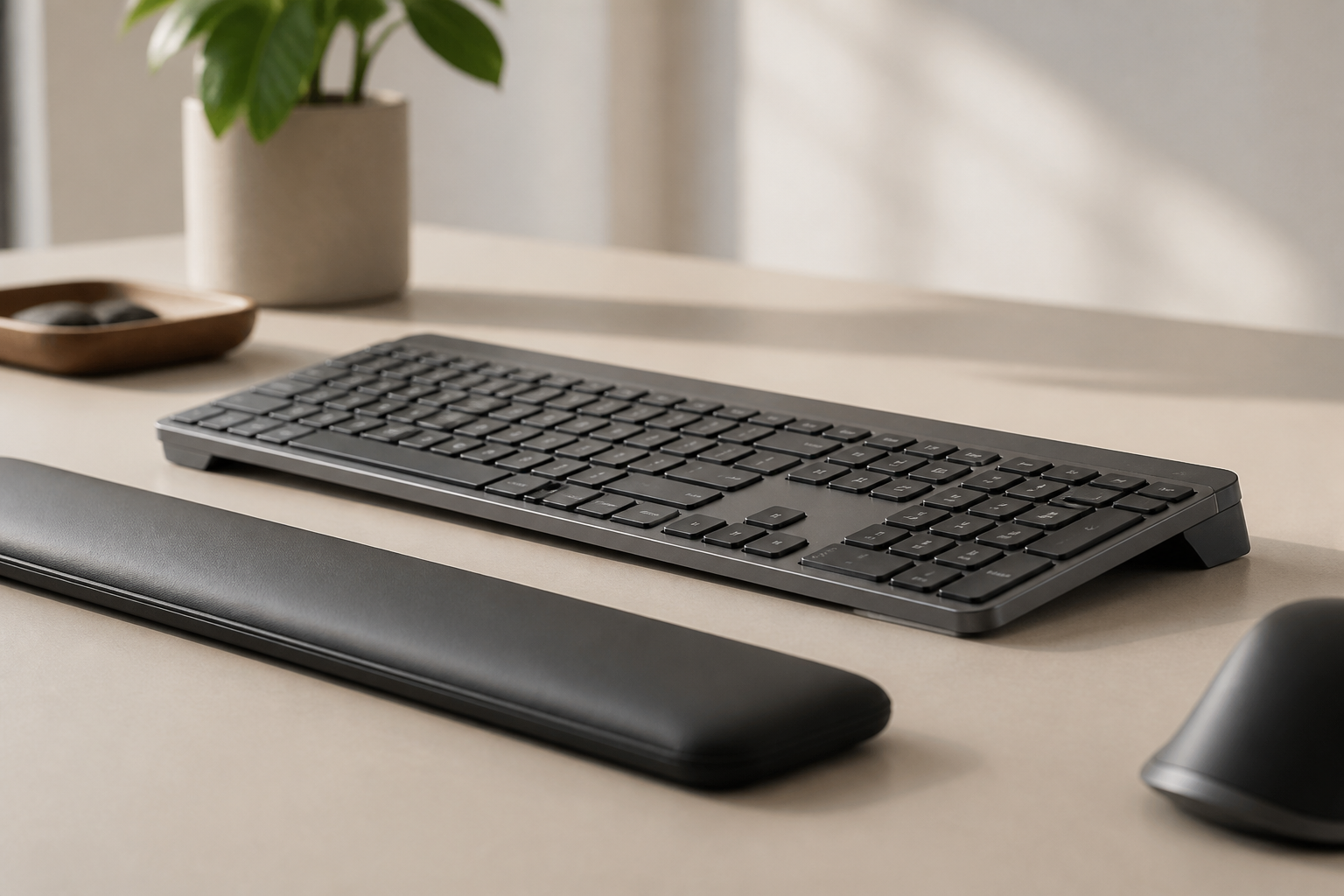



Complete your MX Keys setup
KeyRiser first, then the desk complements
KeyRiser addresses keyboard angle. These recommendations cover adjacent setup needs without replacing it.