Can a Keyboard Riser Make You Type Faster? The Facts
Does a keyboard riser make you type faster? Learn how keyboard angle and wrist position affect sustained typing speed, accuracy, and fatigue during long sessions.
Can a Keyboard Riser Make You Type Faster? The Facts
A keyboard riser is usually bought to reduce wrist pain, not to win a typing race. But the two goals are closer than they look. When your hands feel comfortable, you keep typing instead of stopping to shake them out, re-adjust, or correct mistakes. Over a full workday, those interruptions add up to real lost words per minute. This article looks at how a keyboard riser affects typing speed — not the sprint speed of a 30-second test, but the sustained speed you actually produce in an eight-hour day.
Why typing speed is really about sustained comfort
Most typing-speed tests measure a burst: 30 to 60 seconds of maximum effort. Your best burst is mostly a skill question — how well you know the layout, how fast your fingers move. A keyboard riser will not turn a hunt-and-peck typist into a 100 wpm professional.
The number that matters at work is different. It is the words you produce per hour, all day, week after week. That number is limited by fatigue more than by finger speed. When wrists ache, hands go numb, or forearms tighten, your effective speed drops long before you notice. You slow down slightly, you take extra micro-pauses, and you make more mistakes that cost seconds to fix.
This is where desk setup, keyboard angle, and wrist position enter the picture. A flat keyboard forces your wrists into extension — bent backward. Holding that position for hours creates tension in the forearm muscles and makes small, precise finger movements cost more effort. Anything that reduces that tension tends to raise your sustainable output, even if your peak speed never changes.
What changes when you raise and tilt your keyboard
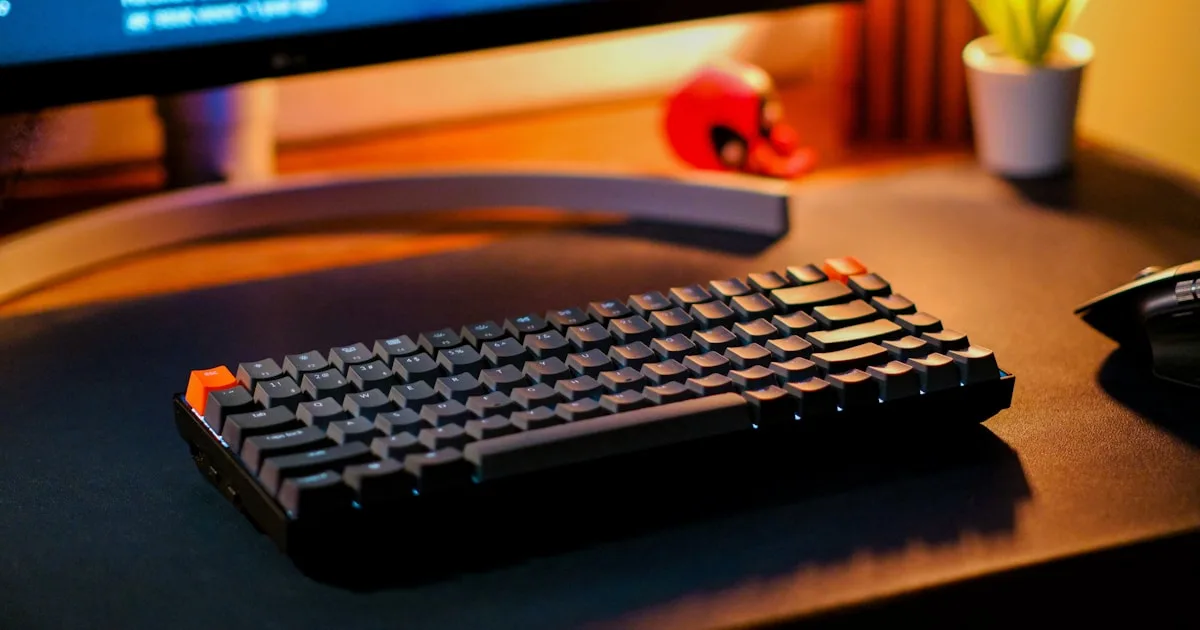
A keyboard riser does two things: it lifts the keyboard and it changes its angle. For a low-profile keyboard like the Logitech MX Keys, the most useful change is a rear lift that brings your wrists closer to neutral.
The mechanics are simple. With the keyboard flat on the desk, most people extend their wrists upward to reach the keys. With a rear tilt of roughly 10–15 degrees, the wrist can rest closer to a straight, neutral line while the fingers keep a relaxed curve over the keys. Neutral wrist posture is the core recommendation of workplace ergonomics guidance, and it is the reason risers exist in the first place.
What does that do for typing? Three things:
- Less muscle tension per keystroke. Relaxed wrists mean the small muscles of the hand and forearm work less hard, so they tire more slowly.
- Fewer interruptions. Comfortable hands mean fewer stretch breaks, fewer wrist shakes, fewer pauses to flex your fingers.
- Better accuracy over time. Fatigue is a known driver of typing errors. Lower fatigue tends to mean cleaner text and fewer correction cycles.
None of these claim that a riser makes your fingers move faster. They describe something more useful: a riser helps you hold your pace instead of fading in the afternoon.
What the ergonomics research actually supports
It is worth being honest about the evidence. There is no study showing that raising a keyboard makes someone type 20% faster in a typing test. The research base for keyboard tilt is about posture, strain, and discomfort, not about speed as a headline number.
What the research does support:
- Wrist extension and deviation are associated with increased discomfort and, over long periods, increased risk of strain. Neutral wrist postures are consistently recommended in workplace ergonomics guidance.
- Reducing awkward postures reduces reported discomfort in laboratory studies, and comfort is strongly linked to sustained performance.
- Typing accuracy declines with fatigue in long sessions; anything that reduces fatigue supports consistent output.
So the honest framing is: a keyboard riser is a comfort tool with a productivity side effect. If you currently stop every twenty minutes because your wrists feel tense, fixing that will raise your real-world output even though your 60-second test score stays flat.
Sprint speed versus marathon speed
Think of typing like running. Your sprint time depends on your training. Your marathon time depends on your pacing, your shoes, and whether your knees hurt at kilometer thirty.
For typists, the marathon is the workday. The person who types 80 wpm in a burst but stops frequently, corrects errors, and loses focus in the afternoon will produce fewer finished words than the steady 65 wpm typist who never needs to stop. Comfort is what keeps you in the steady group.
There is also a less obvious effect: accuracy compounds. A 2% error rate means every fiftieth keystroke is wrong. At 10,000 keystrokes a day, that is two hundred corrections — several minutes of lost time. Fatigue pushes error rates up. Comfort pushes them down.
A five-minute test you can run yourself
You do not need to take our word for it. Here is a simple protocol you can run with your current keyboard:
- Pick a two-minute typing test you know well, and write down your score.
- Type normally for 45–60 minutes, the way you work every day.
- Repeat the same two-minute test. Note the score and how your wrists feel.
- Raise the back of your keyboard by 10–15 degrees (a book or a riser works) and repeat steps 1–3.
- Compare the second set of scores and, more importantly, how your hands feel at the end of the hour.
Most people find the flat-keyboard scores drift downward over the hour, while the tilted setup holds steadier. The difference is rarely dramatic in two minutes — it shows up in your energy at the end of the day.
What a keyboard riser will not do
It is just as important to know the limits. A keyboard riser will not:
- Turn a hunt-and-peck typist into a fast touch typist. Speed still comes from practice and layout familiarity.
- Fix a keyboard that is in the wrong place entirely. If the keyboard sits far away, at the wrong height, or on the wrong side, fix those first — angle is the final polish, not the whole setup.
- Replace rest, medical advice, or treatment. If you have persistent pain, numbness, or a diagnosed condition, a riser is a support for better posture, not a cure. See a professional.
- Compensate for a chair that does not fit. Height and support start with the chair; the keyboard angle works best when the rest of the setup is already reasonable.
Keeping those limits in mind stops a riser from becoming one more gadget you expect to magically fix everything. It is a precise tool for one specific job: changing the angle of the keyboard. When that angle is the problem, it does the job very well.
Who notices the biggest difference
A keyboard riser changes the typing experience most for people who:
- Type for hours at a stretch — programmers, writers, support agents, data entry.
- Use a low-profile keyboard that sits very flat, like the Logitech MX Keys or MX Keys Mini.
- Already feel wrist tension, tingling, or fatigue that gets worse as the day goes on.
- Work on desks where the keyboard cannot be positioned close to elbow height.
If you only type a few emails a day, a riser will not change your speed. If typing is your job, the setup that keeps your wrists neutral for hours is the setup that keeps your output high.
KeyRiser as the practical fix
KeyRiser is a fixed 15-degree keyboard riser designed for the Logitech MX Keys family. The angle is based on the rear-lift range recommended in workplace ergonomics guidance, and the design keeps the keyboard stable and the desk clean. It installs in seconds, needs no tools, and works with the keyboard you already own — no learning curve, no new layout to memorize.
Check the compatibility page to confirm your model, and see our FAQ if you have questions about fit, angle, or materials. You can also browse the full blog for more typing comfort and ergonomics guides.
FAQ
Does a keyboard riser really make you type faster?
Not in a sprint test, usually. It helps with sustained speed: less fatigue, fewer interruptions, and better accuracy over long sessions, which raises your real words-per-hour output.
How long does it take to notice a difference?
Some people feel a difference in hand comfort within the first session. The productivity effect shows up over days — when the afternoon slump stops taking your typing speed with it.
Is typing speed or comfort the real reason to buy a riser?
Comfort is the primary reason. Speed is a welcome side effect of reduced fatigue and fewer errors.
Does a riser help touch typists?
Yes — touch typists benefit most, because their speed is high enough that fatigue and accuracy are the limiting factors, not finger speed.
Can a riser replace an ergonomic keyboard?
It solves a different problem. A riser fixes the angle and height of the keyboard you already have. An ergonomic keyboard changes the layout. For most people with discomfort, the angle fix comes first.
Do I need a riser if I already type fast?
Speed does not protect you from fatigue. Even a fast typist slows down when wrists ache, which is exactly why sustained output — not peak speed — is where a riser helps most.
Will a riser slow me down while I get used to it?
Most people adjust within a session or two. The angle is small enough that muscle memory barely notices, and the comfort benefit arrives immediately.
Ready for a Better Typing Angle?
Check KeyRiser on Amazon and confirm compatibility with your MX Keys model.
Buy Now - $9.99