
The Hidden Cost of Ignoring Wrist Pain: Medical Bills, Lost Productivity, and Long-Term Damage
Ignoring wrist pain does not just affect your comfort — it can cost thousands in medical bills, months of lost work, and permanent nerve damage. Here is what the data shows.
The Hidden Cost of Ignoring Wrist Pain: Medical Bills, Lost Productivity, and Long-Term Damage
A $10 fix today beats a $5,000 surgery tomorrow. Get KeyRiser on Amazon for $9.99 (on sale from $9.99) and support typing comfort before it escalates.
That slight ache in your wrist at 3 PM. The tingling in your fingers that comes and goes. The stiffness you feel when you wake up. Most people dismiss these signals. “It’s just a long week.” “I’ll rest this weekend.” “It’ll go away on its own.”
Sometimes it does. But when it doesn’t — when that mild discomfort evolves into a chronic problem — the costs go far beyond discomfort. We’re talking thousands of dollars in medical bills, months of lost productivity, and in the worst cases, permanent nerve damage that no amount of rest can reverse.
Here is what ignoring wrist pain actually costs — and why the math strongly favors prevention.
The Escalation Path: From Discomfort to Damage
Stage 1: Mild Discomfort (Weeks 1-4)
You notice a dull ache after long typing sessions. It goes away with rest. Maybe your fingers feel slightly stiff in the morning.
What’s happening: Your tendons and the tissues around your carpal tunnel are experiencing repetitive friction. Minor inflammation is starting. At this stage, the damage is fully reversible.
The cost at this stage: Zero dollars in medical bills. Maybe a few hours of mild annoyance. A $10-15 ergonomic adjustment would likely resolve it completely.
Stage 2: Persistent Pain (Weeks 4-12)
The pain no longer goes away overnight. It follows you into the weekend. You might start avoiding activities that aggravate it — gaming, playing an instrument, even simple tasks like opening jars. You take the occasional ibuprofen.
What’s happening: Chronic inflammation is setting in. The synovial sheath around your tendons is thickening. If the carpal tunnel is involved, the median nerve is under sustained pressure. Tissue changes are beginning.
The cost at this stage: Possibly a doctor’s visit ($150-300 out of pocket), some over-the-counter medication ($10-20/month), and the beginning of productivity loss (harder to focus when you’re in pain, maybe 5-10% output reduction).
Stage 3: Functional Impairment (Months 3-12)
You’re now in constant low-grade pain. Numbness and tingling are frequent. You drop things more often. Your grip strength has noticeably decreased. You’ve started wearing a brace at night. You’re googling your symptoms at 2 AM.
What’s happening: If carpal tunnel syndrome has developed, the median nerve is being compressed enough to affect nerve signaling. If it’s tendonitis, chronic inflammation is causing tissue degeneration. The damage is no longer easily reversible with rest alone.
The cost at this stage:
- Specialist consultations: $300-600
- Nerve conduction studies (to diagnose carpal tunnel): $500-1,500
- Physical therapy (8-12 sessions): $600-1,800
- Wrist braces, ergonomic assessments: $100-400
- Productivity loss: 15-25% reduction during peak pain periods
- Estimated total: $1,500-4,300
Stage 4: Surgical Intervention (Year 1-3)
The pain is now severe enough that conservative treatments have failed. Your doctor recommends surgery. Carpal tunnel release surgery is the most common, but thumb CMC joint surgery and tendon release procedures are also possibilities, depending on the condition.
What’s happening: Permanent changes to the affected tissues. Nerve damage may be partially irreversible. Surgery can relieve pressure, but it cannot always restore full nerve function if the compression has been sustained for too long.
The cost at this stage:
- Carpal tunnel release surgery: $2,000-7,000 (varies by country, insurance, and whether it’s open or endoscopic)
- Post-surgical physical therapy: $800-2,000
- Time off work: 2-6 weeks for carpal tunnel; up to 3 months for more complex procedures
- Lost wages during recovery: highly variable — for a freelancer or contractor, this could mean $5,000-30,000+ in lost income
- Estimated total: $3,000-10,000+ (medical) plus lost income
Stage 5: Permanent Consequences (Years 3+)
In the worst cases — when carpal tunnel syndrome goes untreated for years — the median nerve sustains permanent damage. This can mean:
- Permanent numbness in the thumb, index, and middle fingers
- Permanent weakness in grip and pinch
- Muscle wasting at the base of the thumb (thenar atrophy)
- Chronic pain that persists even after surgery
At this stage, existing damage may not fully reverse, and professional assessment may be needed. The goal shifts from “fixing” to “managing.” And for people whose livelihood depends on typing — programmers, writers, data entry professionals, customer support agents — this can mean a career change.
What the Data Says: By the Numbers
Carpal Tunnel Syndrome Costs
According to data from the U.S. Bureau of Labor Statistics and multiple peer-reviewed cost-of-illness studies:
- The median total cost (direct medical + indirect productivity loss) of a carpal tunnel syndrome case that requires surgery ranges from $30,000 to $70,000 when lost wages and long-term disability are factored in
- The average time off work after carpal tunnel release surgery is 28 days for office workers, longer for manual workers
- Approximately 20% of carpal tunnel surgery patients report some level of persistent symptoms one year post-surgery
- Wrist and hand injuries account for roughly 15% of all workplace repetitive strain injuries reported annually
The ROI of Prevention
Now compare that to prevention:
- A keyboard riser that brings your wrists to a neutral position: $10-15
- An ergonomic keyboard tray: $50-200
- An ergonomic desk setup consultation: $100-300
The math is stark: a $10 investment in prevention can avoid thousands of dollars in treatment — and months of pain. Even the most comprehensive ergonomic setup costs less than a single specialist consultation once a problem has progressed to Stage 3.
Why People Ignore Wrist Pain (And Why They Shouldn’t)
“It’s not that bad yet”
This is the most common — and most dangerous — justification. The problem with wrist and nerve conditions is that by the time they feel “bad enough” to take seriously, significant tissue changes have already occurred. The mild ache you feel at Stage 1 is your body’s early warning system. Waiting until Stage 3 or 4 to act is like waiting until your car’s engine seizes before changing the oil.
”I can’t afford ergonomic equipment right now”
This perspective looks at the $10-100 cost of prevention without considering the $3,000-10,000+ cost of treatment. It’s a short-term savings mindset that creates a much larger long-term expense. If you type for a living, ergonomic equipment is not a luxury purchase — it’s insurance for your primary income-generating tool: your hands.
”I know someone who typed for 30 years with no issues”
Individual variability exists. Some people have naturally wider carpal tunnels. Some have more resilient tendon sheaths. Some type with less force. But “it didn’t happen to them” is not a strategy — it’s gambling with your health. And the odds are not in your favor: an estimated 3-6% of the adult population will develop carpal tunnel syndrome in their lifetime, with rates significantly higher among heavy computer users.
What You Can Do Today
1. Recognize the Warning Signs
Take wrist pain seriously when:
- It persists for more than 2 weeks without improvement
- It interrupts your sleep
- You feel numbness, tingling, or burning in your thumb, index, or middle fingers
- You notice declining grip strength
- The pain radiates up your forearm
2. Fix Your Keyboard Angle (The Single Biggest Impact)
A flat keyboard forces your wrists into extension for thousands of hours per year. Raising the rear edge by approximately 15 degrees brings your wrists closer to neutral, reducing carpal tunnel pressure and tendon friction.
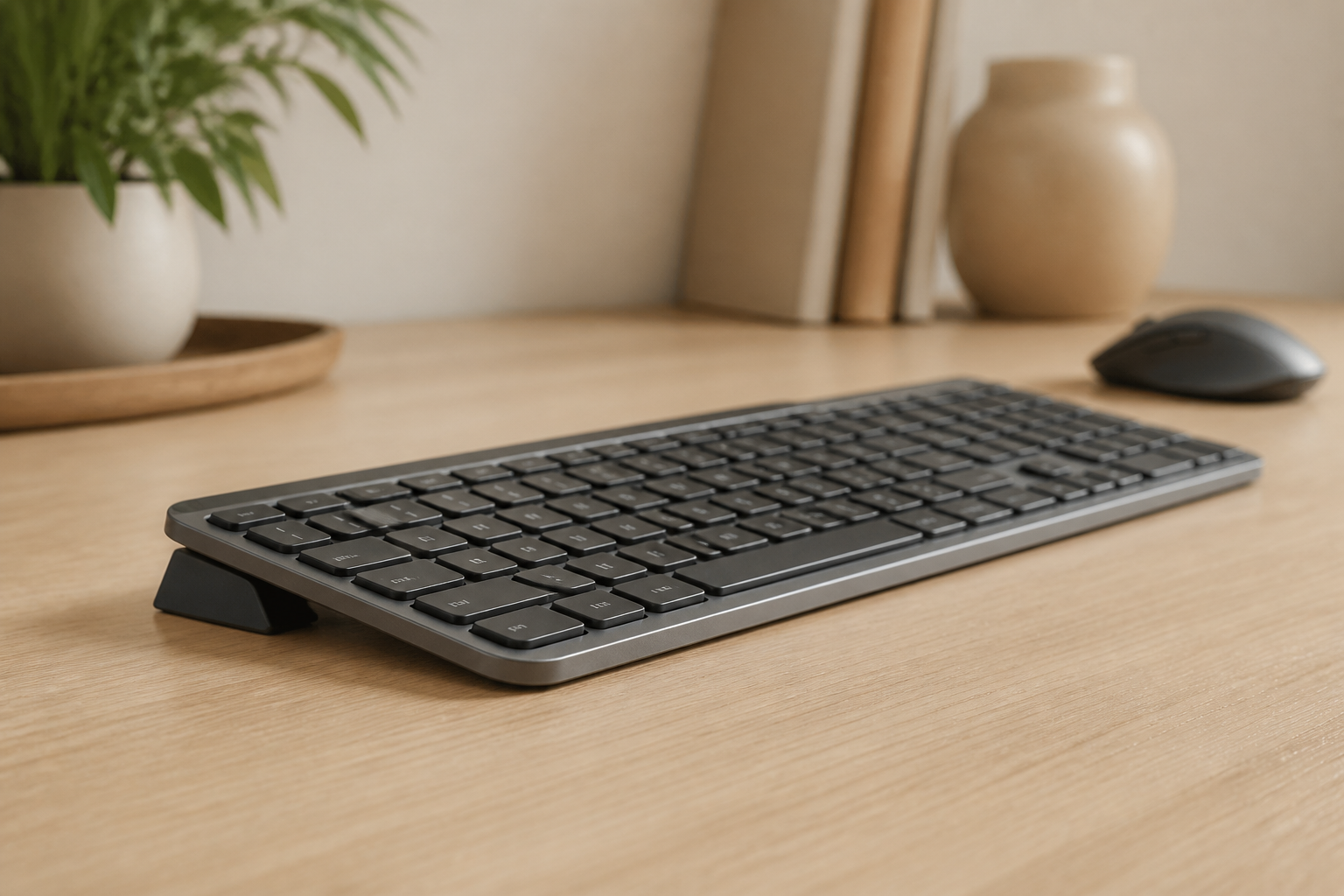
For Logitech MX Keys, MX Keys S, and MX Keys Mini users — whose keyboards ship with no adjustable feet — a clip-on riser like KeyRiser provides the 15° rear lift in seconds. No tools, no modifications, and completely removable.
3. Act Early
The difference between a $10 fix and a $5,000 surgery is often just time — the time between when you first notice the discomfort and when you take action. The earlier you intervene, the simpler, cheaper, and more effective the solution.
4. Advocate for Workplace Ergonomics
If you’re an employee, many employers provide ergonomic equipment or assessments at no cost to you. The employer’s incentive is real: a single workers’ compensation claim for carpal tunnel syndrome can cost them $30,000 or more. A keyboard riser costs $15. Ask.
If you’re self-employed or freelance, remember: you are your own most valuable asset. Protecting your ability to work is a business expense — and one of the highest-ROI investments you can make.
The Bottom Line
Wrist pain is not just a comfort issue. Left unchecked, it follows a predictable escalation path from mild discomfort to chronic injury to surgical intervention — with costs that increase exponentially at each stage.
The math is simple: prevention costs 0.2% of what treatment costs.
A $10-15 keyboard riser that fixes your typing angle today is worth more than a $5,000 surgery and two months of lost income tomorrow. Your future self — with functional, More Comfortable hands — will thank you for acting now.
Prevention starts at your keyboard. Get KeyRiser on Amazon for $9.99 (on sale from $9.99). 15° fixed angle designed for Logitech MX Keys, MX Keys S, and MX Keys Mini. Small investment. Big return.
Disclaimer: This article is for informational purposes only. The cost estimates provided are based on published research and may vary by country, insurance coverage, and individual circumstances. This is not medical or financial advice. If you are experiencing persistent wrist pain, consult a qualified healthcare professional. If you have a known or suspected wrist condition, consult your doctor before making changes to your ergonomic setup.
Ready for a Better Typing Angle?
Check KeyRiser on Amazon and confirm compatibility with your MX Keys model.
Buy Now - $9.99Related Articles



Complete your MX Keys setup
KeyRiser first, then the desk complements
KeyRiser addresses keyboard angle. These recommendations cover adjacent setup needs without replacing it.